
[CPU] Is a Developer Still a Developer Without the Code?
When it comes to tech, what makes humans human?

Greetings, Programs!
In prepping for this weekend’s live tech event, I was smacked with gatekeeping.
There is a peculiar kind of gatekeeping that happens when a new tool democratizes a difficult art. We see it in photography, where “real” photographers once scoffed at digital sensors. We saw it in music, where synthesized drums were dismissed as soulless. And we are seeing it now, perhaps more intensely than ever, in the world of software creation.
Consider the pianist. Imagine someone who sits down at a grand piano and plays with a ferocity and tenderness that brings an audience to tears. They understand the weight of the keys. They know instinctively how to resolve a chord in a way that feels like a question being answered. They can improvise, compose, and transport a room full of people to a different emotional plane.
Now, imagine you find out they cannot read a single note of sheet music. To them, the staff and the treble clef are indecipherable hieroglyphs. They do not know the Italian terms for tempo or the formal structure of a sonata. They just play. They hear the music in their head, and their hands translate it into sound.
Does this lack of academic literacy make them any less of a musician? Is the music they create less valid because they bypassed the traditional mechanism of transcription? If their art moves you, inspires you, and exists in the world as a tangible, beautiful thing, are they to be admonished for not knowing the theory behind it?
Of course not. We celebrate them. We call them savants or naturals. We recognize that the sheet music is not the music itself; it is merely a notation system - a set of instructions for reproducing the music. The music is the outcome. The notation is just the code.
We are currently standing at the precipice of a similar realization in technology. For decades, the ability to build software was inextricably linked to the ability to write code. If you wanted to create an application, you had to learn the syntax. You had to understand memory management, object-oriented design, and the intricacies of the compiler. The “sheet music” of software was complex, unforgiving, and accessible only to those who spent years mastering it.
A vibe coder could be the non-technical creator who sits down at the modern equivalent of that grand piano - an AI-driven development environment - and plays. They do not know how to write a React component from scratch. They cannot explain the difference between a bubble sort and a quick sort. They might not even know what a variable is in the strictest computer science sense. Yet, they can describe what they want. They can feel the flow of the application. They can iterate, tweak, and guide the AI to produce a piece of software that works, serves a purpose, and delights its users.
There is a temptation among the “classically trained” - the software engineers who have spent their lives learning to read the sheet music - to dismiss this. They look at the code generated by an AI under the guidance of a novice and see inefficiencies. They see a lack of structural purity. They see a “musician” who doesn’t know their scales.
But if the app works, does it matter? If a non-technical person can “vibe code” a solution that solves a real problem for them or their community, does that make them lesser? Or does it simply make them a different kind of creator?
The tragedy of the old world was that millions of brilliant ideas died in the minds of people who couldn’t write code. The barrier to entry was simply too high. It was as if we told every potential storyteller that they couldn’t write a novel unless they first learned to build a printing press and bind a book by hand. We conflated the mechanism of production with the act of creation.
What we are witnessing now is the decoupling of those two things. The mechanism of production is being automated. The “sheet music” is being written by the machine. This leaves the human to focus on the melody, the rhythm, and the emotion of the piece. It elevates the *intent* of the creator over their technical proficiency.
This does not render the traditional software engineer obsolete, just as the existence of jazz pianists who play by ear didn’t render composers or conductors obsolete. There will always be a need for those who understand the deep theory, who can push the boundaries of the instrument itself, and who can construct the systems that the rest of us play upon. The engineers of tomorrow may be the ones building the AI pianos that the vibe coders play.
But we must stop pretending that the syntax is the value. The code is not the product. The code is the liability. The code is the thing that has to be maintained, debugged, and refactored. The *value* is what the software does for the human being at the other end. And if a vibe coder can deliver that value by humming a tune to an AI, they are every bit as much a “developer” as the person who types every character by hand.
We are moving toward a world where the ability to imagine a system is more important than the ability to implement it. This is a frightening shift for those of us who have built our identities around our implementation skills. It feels like a loss of control. It feels like the unwashed masses are storming the gates of our ivory tower.
But look at what they are building. Look at the joy in the “App Showcase” section below. These are not enterprise-grade SaaS platforms built by teams of hundreds. They are whimsical, personal, strange, and beautiful little tools. They are digital receipt generators, 3D optical labs, and Star Wars translators. They are the software equivalent of folk music. They are raw, authentic, and deeply human.
To admonish the vibe coder is to admonish the human spirit’s desire to create. It is to say, “You are not allowed to build this because you did not suffer through the same tutorials I did.” It is a petty, small-minded stance that ignores the history of every technological advancement we have ever made.
Every layer of abstraction in computing history - from punch cards to assembly, from assembly to C, from C to Python - has been about moving further away from the machine and closer to the intent. AI is simply the next logical step. It is the ultimate abstraction layer. It removes the syntax entirely and leaves only the logic and the desire. I’m old enough to remember COBOL and BASIC!
So let the pianists play, whether they can read the notes or not. Let the vibe coders build, whether they understand the stack or not. The world is full of problems that need solving and dreams that need building. We should welcome anyone who picks up an instrument and tries to make a sound.
The music is what matters. Everything else is just implementation details.
Our Recent Event’s Keyword Was “Music!”
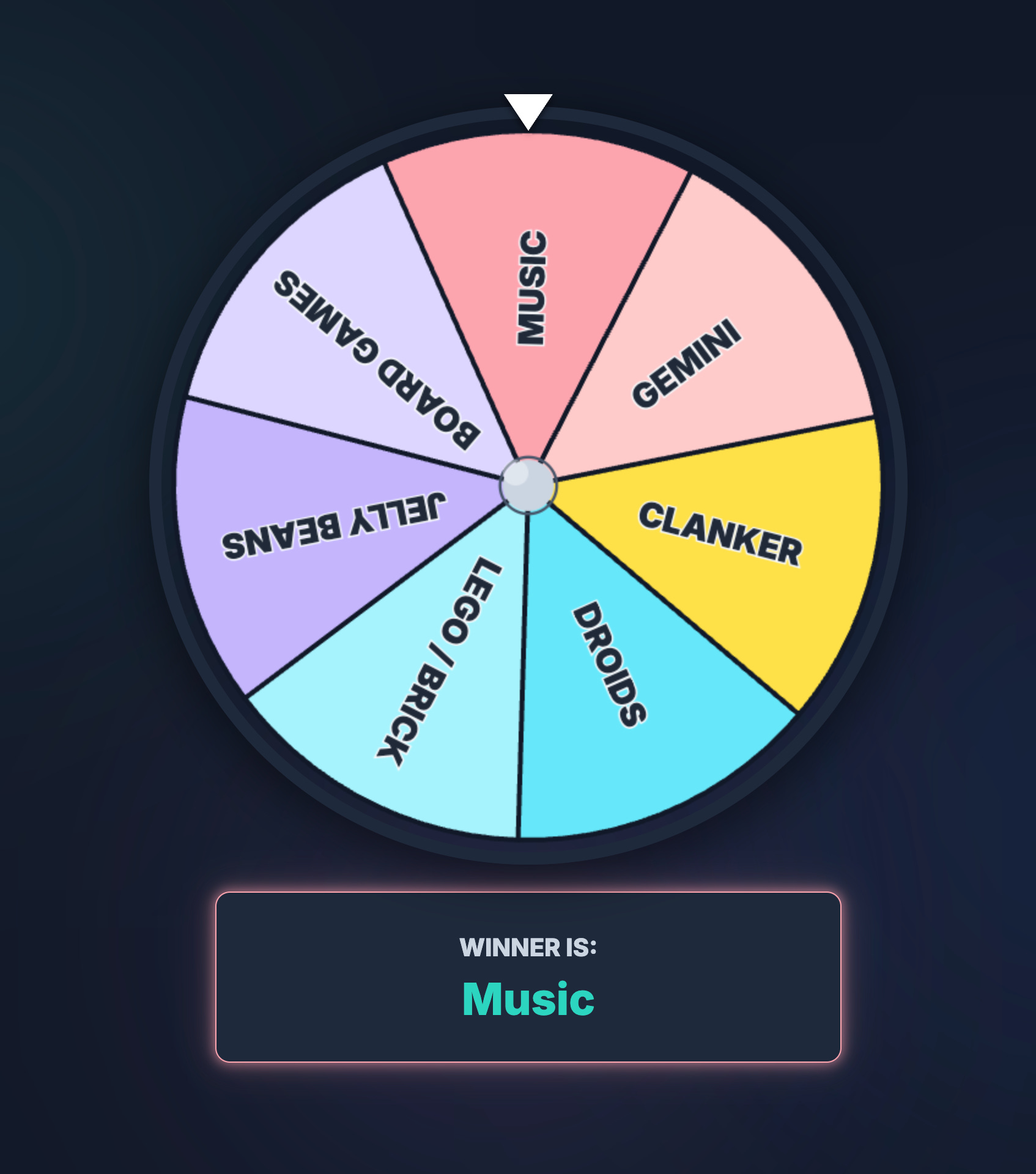
I fiddled with a few things but found myself fleshing out a simple piano game and something that reminded me of childhood.
Fresh from the “Compiler”
404 Not Found
Engage with a tactile 3D paper receipt featuring a cloth physics engine. Drag, ripple, and interact with this unique 404 error page experience.
Aurebesh Forge: 3D-Printable Star Wars Sign Maker
Create and export custom 3D-printable nameplates using Star Wars Aurebesh script. Adjust geometry and styles for perfect 3D prints.
Aurebesh Trainer: Galactic Alphabet Mastery
Master the Star Wars Aurebesh alphabet with this interactive trainer. Identify glyphs, track high scores, and export custom translation cheat sheets.
S9-SYS Aurebesh Tactical Translator
Convert Galactic Basic to Aurebesh with this immersive CRT terminal. Features customizable phosphor colors and high-res image export.
Business CADs | 3D Printable Business Card Designer
Design and export 3D-printable business cards with custom embossed text, integrated QR codes, or SVG graphics in this precision CAD utility.
Crystal Cluster: Entropy Engine
Interactive 3D generative art tool simulating molecular chaos. Customize crystal growth, explosion forces, and cinematic lighting in real-time.
Disco Ball: 3D Optical Lab
Immersive 3D disco ball visualizer featuring a reflective mirror core, dynamic nebulae, and customizable starfields in a high-fidelity generative environment.
Generative Geode: 3D Mineral Lab
Explore and customize procedural 3D geodes with adjustable mineral growth, agate striations, and crystal formations using real-time simulation.
Golden Ear: 3D Pitch Master
Master your musical ear in this immersive 3D piano training app. Identify target frequencies on a virtual keyboard to build your perfect pitch streak.
Heartfelt: Cinematic Rain & Heart Visualizer
An immersive WebGL rain simulator on glass featuring customizable fog, lightning, heart-shaped mist, and interactive atmospheric controls.
Huttese Protocol Translator
Translate Galactic Basic to Huttese in real-time with this immersive Star Wars-themed tool featuring a massive searchable lexicon and common phrase bank.
Maker Plaques | 3D Signage Studio & STL Generator
Generate custom 3D printed plaques with SVG logos, QR codes, and text. Real-time 3D preview, production-ready STL and 3MF exports.
Imperial Command: DS-1 Tactical Dashboard
A high-tech, interactive Star Wars-inspired tactical dashboard simulating the control systems of the DS-1 orbital station with real-time telemetry.
Noise Bleed: Liquid Chaos Visualizer
An interactive WebGL experience generating complex domain-warped noise patterns and liquid textures with granular fBM and color controls.
Glass Lattice Voronoi Explorer
Create stunning generative art with this 3D Voronoi lattice explorer featuring physically-inspired refraction, custom environment maps, and 4K exports.
Silent Liquidity: Advanced Fluid Visualizer
A high-end physically-simulated fluid distortion studio. Customize optics, physics, and surface textures to create and export 4K liquid wallpapers.
SVG Vectorify | Pro Image to SVG Converter
I needed a way to quickly create valid SVG files for my other apps. Figured I’d release the tool for y’all to use, too! SVGs are the “new” hotness.
Unamerican Graffiti
Well, I couldn’t come up with a better title for this visualization. Should generate some great wallpapers for you, though.
Voice Keyboard | SK-X Sampler Ultra Pro
The only keyboard I ever wanted as a kid was the Casio SK-1. I wound up getting one of those for my daughter, but… I thought… why not vibe one, too? Kinda.
My favorites from this batch?


Hey, even if you don’t look at any of these today, they’re all listed in my online arcade (and will be indefinitely). I’m definitely doing web apps better now than I was when I started a year ago! That’s how it’s supposed to work. Had to start somewhere. Never have to finish, though.
Mark Your Calendars
ctrl + alt + create live marches on! The central headquarters for the vibe coding revolution - if you want to know how we are democratizing software creation for non-technical dreamers, this is your starting point.
The Vibe Coding Calendar: Subscribe to the official calendar to catch every pop-up workshop, live stream, and hybrid event before the spots fill up.
The Next Vibe Coding Workshop: This weekend! (Seattle, WA & Online). It’s another A hands-on, hybrid workshop where we prove that anyone can build software in under two hours—perfect for the “tech-adjacent” who are tired of waiting for engineering tickets.
We’ve scheduled our March hybrid event, too!
Bookmarks for the Post-Code Era
ClawBeat: The Pulse of OpenClaw
As we move deeper into 2026, the “agentic” web is becoming less of a buzzword and more of a utility layer. ClawBeat has emerged as the definitive intelligence feed for the OpenClaw ecosystem, curating the latest on autonomous agents that don’t just chat, but actually do. It’s a fascinating glimpse into the infrastructure that is slowly replacing traditional APIs.
Patty: When AI Demands “Please” and “Thank You”
Burger King’s new AI assistant, “Patty,” lives inside employee headsets, monitoring their interactions for “friendliness” and grading them on their politeness. It is a dystopian collision of service work and surveillance capitalism, where the machine doesn’t just automate the burger flipping but actively polices the emotional labor of the human staff. A grim reminder that “vibe coding” isn’t the only way AI is reshaping the workplace.
Karpathy’s Decree: The Manual Era is Over
Andrej Karpathy, a voice of reason in the AI noise, has effectively called time of death on manual programming. His latest thoughts suggest that the role of the human is shifting entirely from “writer of code” to “manager of delegation.” If the former Director of AI at Tesla says the syntax era is done, it’s probably time to stop arguing about linter settings and start learning how to direct the orchestra.
The Digital Worker Arrives
I have been watching the rollout of Perplexity’s new “Computer” service with a mix of awe and existential vertigo. If you haven’t seen it, it looks - at least from a distance - like the fulfillment of the “agent” promise we’ve been hearing about for years. This isn’t a chatbot that gives you a recipe for sourdough. This is a system that creates and executes entire workflows. It can run for hours. It can run for months.
Think about that. You give it a goal, and it goes away to work. It doesn’t need you to tab-complete its sentences. It doesn’t need you to debug its logic. It just... works. It is the difference between having a calculator and having an accountant.
I wonder where we’ll be with all of this a year from now? If we have systems that can execute month-long workflows in 2026, what does 2027 look like? Do we even have “apps” anymore, or just ephemeral interfaces generated on the fly to suit our momentary needs?
Here’s to hoping that humanity finds a path forward in all of this. It is easy to get lost in the sauce of “productivity” and forget that the point of all this automation should be to free us up for the things that machines can’t do. But as the machines get better at art, music, and code, that list of “things machines can’t do” is getting uncomfortably short.
Tech isn’t what it used to be. It’s no longer about the specs, the clock speeds, or the compilers. And tech will never be the same again. We are all just pianists now, trying to find a melody in a world that is rapidly learning to play itself.
Yours Digitally,